
Buying guide
Buying a ski property in the French Alps: the buyer's guide
Alpine Property Investments has written a 26-page buyer's guide to purchasing in the French Alps. This page is the short version, with the sections that matter most for Les Sybelles; download the full guide for the detail, the worked examples and the resort directory.
Download the full guide (PDF, 26 pages)
The Complete Buyer's Guide to The French Alps, 2026 edition, by Alpine Property Investments: the market case, choosing a resort, VEFA versus resale, the numbers, VAT, tax, inheritance, financing and the post-Brexit position.
Why the French Alps
- Constrained supply: planning limits and steep terrain mean desirable resorts cannot expand indefinitely.
- A genuine dual-season market: summer trade, hiking, cycling and remote working now extend the season well beyond the classic holiday weeks.
- Snow security: higher-altitude resorts and north-facing terrain offer the most reliable conditions in a warming climate.
- Accessibility: Geneva, Lyon, Grenoble and Chambéry airports put most resorts within a 1–3 hour transfer; the Eurostar/TGV network adds a low-friction alternative.
- A secure legal framework: a mature, notaire-supervised conveyancing system, strong consumer protection on new-build and no restrictions on foreign ownership.
- Lifestyle, investment or both? The guide's advice: if the property must cover a meaningful share of its running costs, let rental performance drive the choice; if it is primarily a family base, buy where you genuinely want to be and treat rental income as a bonus.
Choosing your resort: six criteria
- Altitude and snow record.
- Access: transfer time of around 90 minutes or less suits regular short stays.
- Dual-season strength: a real summer economy can add 4–8 lettable weeks a year.
- Rental demand and the depth of the local managed-rental market.
- Resort character: purpose-built convenience versus traditional village character (look for the Famille Plus label if children are central).
- Budget fit: entry prices range from around €7,000 per m² in emerging resorts to €50,000+ in the most prestigious. The guide places Saint-Sorlin-d'Arves and La Toussuire in its 'emerging value' tier, with Les Sybelles described as the fourth-largest linked ski area in France and the seventh-largest in Europe.
New-build (VEFA) or resale?
- New-build in France is usually sold off-plan under a VEFA contract (sale in a future state of completion), a heavily regulated, buyer-protective structure.
- Staged payments capped by law: roughly 25–35 % at foundations, 70 % when watertight, 95 % at completion, the balance on handover.
- Completion guarantee: the developer must provide a bank-backed garantie financière d'achèvement; the reservation deposit is held in the notaire's escrow account.
- Warranties: one year of perfect completion, two years on equipment, a ten-year structural guarantee (garantie décennale).
- Reduced purchase costs: notaire fees commonly around 2–2.5 % on new-build versus roughly 7–8 % on resales; new properties may also qualify for a two-year taxe foncière exemption, subject to local rules.
- VAT recovery potential with a qualifying furnished rental activity (see below). The trade-off: you are buying from plans and completion is typically 18–30 months away.
The buying process, step by step
- Offer and reservation or compromis de vente, with a ten-day cooling-off period for the buyer.
- Deposit held by the notaire; mortgage application and searches, typically two to three months from offer to legal completion.
- Acte authentique signed at the notaire's office (or by power of attorney, so completion is possible without travelling to France).
- Off-plan: handover of the finished property follows the build, typically 18 to 30 months.
The real numbers
- One-off costs: notaire fees (c. 2–2.5 % new-build, c. 7–8 % resale), mortgage arrangement and valuation fees, currency costs, furniture.
- Annual running costs: taxe foncière, copropriété charges, insurance, utilities and management fees if you let.
- Wealth tax (IFI) applies to French property holdings above €1.3 million net of qualifying debt, on a banded scale.
Rental income and the 20 % VAT rebate
- A new-build price includes 20 % VAT. With a qualifying furnished rental activity offering hotel-style services, that VAT can be recovered: on a VAT-inclusive price of €500,000 the VAT element is €83,333, giving a net cost of €416,667 (the guide's own worked example). The VAT element is one-sixth of the total, not a 20 % discount.
- The rental commitment runs for 20 years; selling or stopping the qualifying activity earlier triggers a pro-rata adjustment.
- Three contract types: Classic Freehold (no rental obligation, so no VAT rebate), Loi Montagne (owner-let with services; personal use typically four to eight weeks a year) and Résidence de Tourisme (leaseback with an operator).
- Rental income is taxed in France, most often under the LMNP furnished-letting regime, with UK credit under the double-tax treaty so income is not taxed twice.
Selling later
- French capital gains tax at 19 % with taper relief, fully exempt after 22 years of ownership; social charges at 17.2 % (7.5 % in certain cases for UK residents) with full exemption after 30 years.
Ownership structures and inheritance
- Buy personally, in indivision (joint names) or through an SCI or SARL; an SCI is not suited to furnished letting without care.
- France applies forced heirship: a reserved share of the estate must pass to children. EU Succession Regulation lets an owner elect the law of their nationality in a properly drafted will; French inheritance tax still applies (spouses exempt; each child has a €100,000 tax-free allowance). Joint-purchase clauses such as the clause tontine can help; a short conversation with a cross-border adviser at purchase resolves most of it.
Financing your purchase
- French banks lend to qualifying non-residents; loan-to-value depends on nationality, residence, income and the property. UK buyers can be asked for a larger deposit than EU borrowers. Loans typically range to 70 %, occasionally 80 %.
- Affordability-driven lending: all debt repayments assessed against household income, with thorough documentation.
- Long-term fixed rates are the norm, typically 15, 20 or 25 years; interest-only options exist but are less common.
- Currency: a specialist currency broker and forward contracts let you fix the rate for staged VEFA payments.
For UK buyers: the post-Brexit position
- Brexit changed nothing about the right to buy: no restrictions on UK citizens owning French property.
- The 90/180 rule: without a visa, UK citizens can spend up to 90 days in any rolling 180-day period in the Schengen area, ample for most holiday-home owners; longer stays need a long-stay visa.
- Property does not equal residency; owning a home supports a visa application but does not replace it.
- Rental income is declared in both countries with treaty relief; French banks continue to lend to UK buyers.
Quick answers
Can foreigners buy property in France?
Yes. There are no general nationality restrictions on buying property in France, although ownership does not by itself grant any right of residence.
Can British buyers still buy a ski property in the French Alps after Brexit?
Yes. UK citizens face no restrictions on owning French property, so buying a ski apartment or chalet in the Alps works just as it did before Brexit. What has changed is how long you can stay: without a visa you can spend up to 90 days in any rolling 180-day period in the Schengen area, which is enough for most holiday-home owners. Longer stays need a long-stay visa, because owning a home in France can support a visa application but does not give you residency. French banks also continue to lend to UK buyers.
How much does it cost to buy a property in France?
On top of the price, budget for notaire fees and taxes of around 7–8 % on a resale or around 2–2.5 % on a new build, whose price already includes 20 % VAT. On a €400,000 resale that is roughly €28,000–32,000; on a €400,000 new build, roughly €8,000–10,000. Other one-off costs can include mortgage fees, currency transfer costs and furniture.
How does the French buying process work and how long does it take?
A resale purchase usually takes two to three months from your offer to legal completion. Buying off-plan takes longer, as handover of a new build follows its construction, which typically runs 18 to 30 months. First you make an offer and sign a reservation contract or compromis de vente, after which you have a ten-day cooling-off period. Your deposit is held by the notaire while the searches are done and any mortgage is arranged. The sale completes when the acte authentique is signed at the notaire's office; with a power of attorney you can complete without travelling to France.
Can I get a mortgage on a French property as a UK resident?
Yes. Qualifying non-residents, UK buyers among them, can borrow from French banks, typically up to 70 % of the price and occasionally 80 %. The amount, deposit and terms depend on your nationality, residence, income, assets, age, the property type and the intended rental structure. UK buyers can be asked for a larger deposit than EU borrowers. Lending is based on affordability: banks assess all your debt repayments against household income and ask for thorough documentation. Long-term fixed rates over 15, 20 or 25 years are the norm, while interest-only loans exist but are less common.
Do I have to rent out my property?
No. If you want to avoid renting, choose a Classic Freehold property, which has no rental obligation. With Classic Freehold you can still rent and reclaim the 20 % VAT rebate on a new build using a local agency. Loi Montagne and Résidence de Tourisme properties carry mandatory rental obligations, with owner usage dependent on the specific project.
Is my deposit safe on an off-plan purchase?
Yes, your deposit is protected on a VEFA off-plan purchase. French VEFA purchases contain strong safeguards and are fully regulated. The reservation deposit of between 2-5% is held in the notaire's escrow account and stage payments are capped by law. A developer must provide a GFA (bank guarantee) before the final deed is signed to ensure the bank will step in to complete construction if the developer for any reason cannot complete the development.
Can I complete without travelling to France?
In many cases, yes. A power of attorney and the notaire's approved remote identification and signing procedures can allow completion without travelling.
Is the VAT rebate on a new build simply a 20 % discount?
No. It is a refund of the VAT on the purchase price and is open only to owners who let the property as a VAT-charging business, such as renting it through a local agency in the resort as a furnished let with at least three of four hotel-type services (breakfast, cleaning, linen and reception). This only applies to new build properties. The purchase price documented in the contracts and mortgage applied for is always the VAT inclusive price. VAT is reclaimed retrospectively. The VAT reclaimed is one-sixth of a VAT-inclusive price, so €83,333 on €500,000. For buyers of Classic Freehold properties who wish to stop renting within 20 years, there is an amount repayable calculated on a one-twentieth per year rented deduction. For example after 20 years, there is nothing to repay, 10 years 50%, 5 years 75% of VAT reclaimed. Alpine Property Investments would be pleased to introduce you to specialists we have been recommending for over 15 years to assist with reclaiming VAT.
Do I need a structural survey?
A survey is not automatically part of the French buying process; properties are sold as seen and the seller supplies statutory diagnostic reports. Buyers of older or extensively renovated properties may wish to commission one.
Listen: the buying process explained
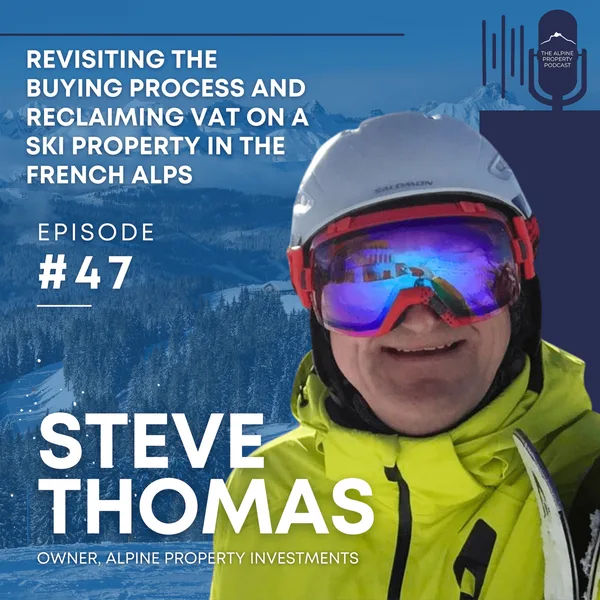
Alpine Property Podcast, episode 47: Revisiting the buying process and reclaiming VAT on a ski property in the French Alps.
Your next step
A short discovery call with Steve or Lesley to match your brief against what is for sale in La Toussuire and St Sorlin d'Arves.
This page summarises Alpine Property Investments' buyer's guide (2026 edition). It is general information, not legal, tax or financial advice; figures are typical and every purchase should be confirmed with the notaire and a tax adviser before committing.